
Break of Structure (BOS) and Change of Character (CHoCH): A Complete SMC Guide
Break of Structure and Change of Character are two important concepts used to interpret price behavior within Smart Money Concepts (SMC). Traders use BOS and CHoCH to understand whether the existing market structure is continuing or whether price may be showing a potential change in market behavior.
Before identifying a BOS or CHoCH, traders need to understand the existing market structure. Price must first establish a sequence of Higher Highs (HH), Higher Lows (HL), Lower Highs (LH), or Lower Lows (LL). Once that structure is clear, a trader can evaluate how price interacts with important structural levels.
In a bullish market, price generally forms Higher Highs and Higher Lows. In a bearish market, price generally forms Lower Highs and Lower Lows. When price breaks an important structural level, that event can provide information about whether the existing trend is continuing or whether market behavior may be changing.
This is where BOS and CHoCH become useful.
A simplified SMC sequence is:
Market Structure → BOS / CHoCH → Liquidity → FVG / Order Block → Trade Execution
BOS is generally used to identify structural continuation, while CHoCH is commonly used to identify a potential change in the current market behavior.
However, neither concept should be treated as an automatic entry signal. Context, timeframe, liquidity, price action, and risk management remain important.
What Is Break of Structure (BOS)?
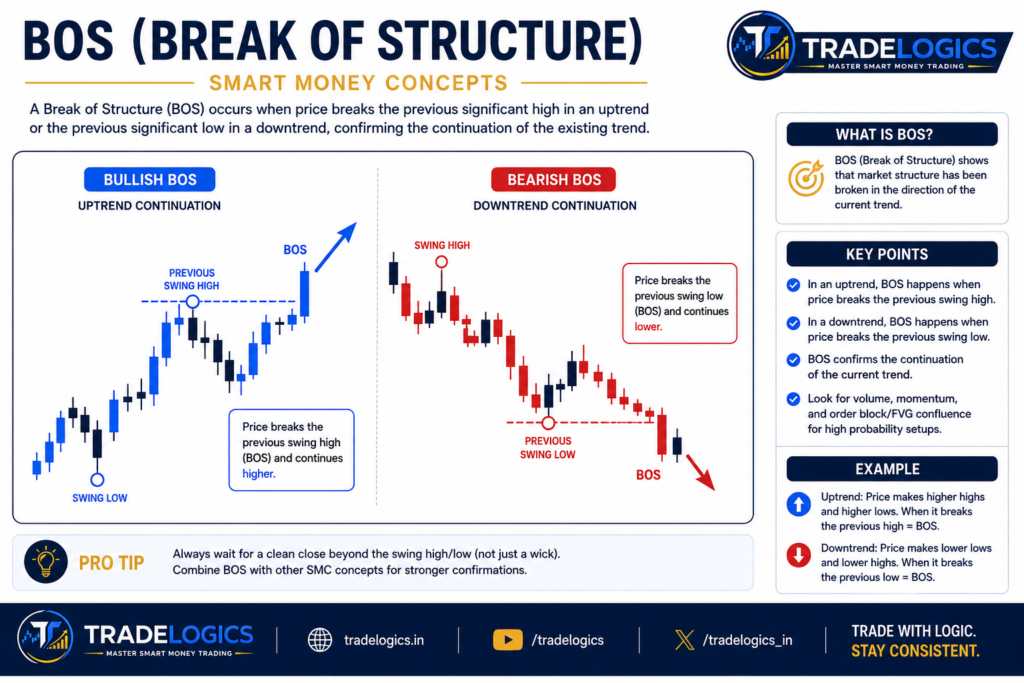
Break of Structure (BOS) occurs when price breaks a significant structural high or low in the direction of the prevailing market structure.
The key idea is continuation.
If the market is already showing bullish structure and price breaks an important previous high, that break can be interpreted as bullish BOS.
If the market is already showing bearish structure and price breaks an important previous low, that break can be interpreted as bearish BOS.
The basic relationship is:
Bullish Structure + Break Above Significant High = Bullish BOS
Bearish Structure + Break Below Significant Low = Bearish BOS
The quality of the BOS depends on which structural level has been broken and the context surrounding that break.
Bullish BOS
A bullish BOS occurs when price breaks above an important previous swing high while the market is displaying bullish structural behavior.
Consider the sequence:
HH → HL → HH
If price then moves above the previous significant HH, the break can be interpreted as a bullish BOS.
The structure can be visualized as:
HH → HL → HH → BOS
The break demonstrates that buyers have pushed price beyond a previous structural high.
What Bullish BOS Tells Traders
A bullish BOS can indicate that the existing upward structure is continuing.
It does not necessarily mean that price will continue upward without a pullback.
After a structural break, price may:
- Continue higher immediately.
- Retrace toward a previous area of interest.
- Return toward an FVG.
- Retrace into an Order Block.
- Sweep liquidity before continuing.
- Consolidate before another expansion.
Therefore, BOS provides structural information rather than a guaranteed entry.
Bearish BOS
A bearish BOS occurs when price breaks below an important previous swing low while the market is displaying bearish structural behavior.
Consider:
LL → LH → LL
If price then breaks below the previous significant LL, the movement can be interpreted as a bearish BOS.
The structure becomes:
LL → LH → LL → BOS
The break demonstrates that sellers have pushed price below an important structural low.
What Bearish BOS Tells Traders
A bearish BOS can indicate continuation of the existing bearish structure.
However, the break itself does not automatically provide a sell entry.
Price may continue lower, retrace, form a new structure, or return to an area such as an FVG or Order Block.
The structural context should therefore remain the priority.
What Is Change of Character (CHoCH)?
Change of Character (CHoCH) is commonly used in SMC to describe a significant break against the prevailing market structure that may indicate a potential change in market behavior.
The key word is potential.
CHoCH does not guarantee that a complete trend reversal will occur.
Instead, it can provide an early indication that the previous directional behavior may be weakening or changing.
For example, suppose a market has been producing:
HH → HL → HH → HL
This is bullish structure.
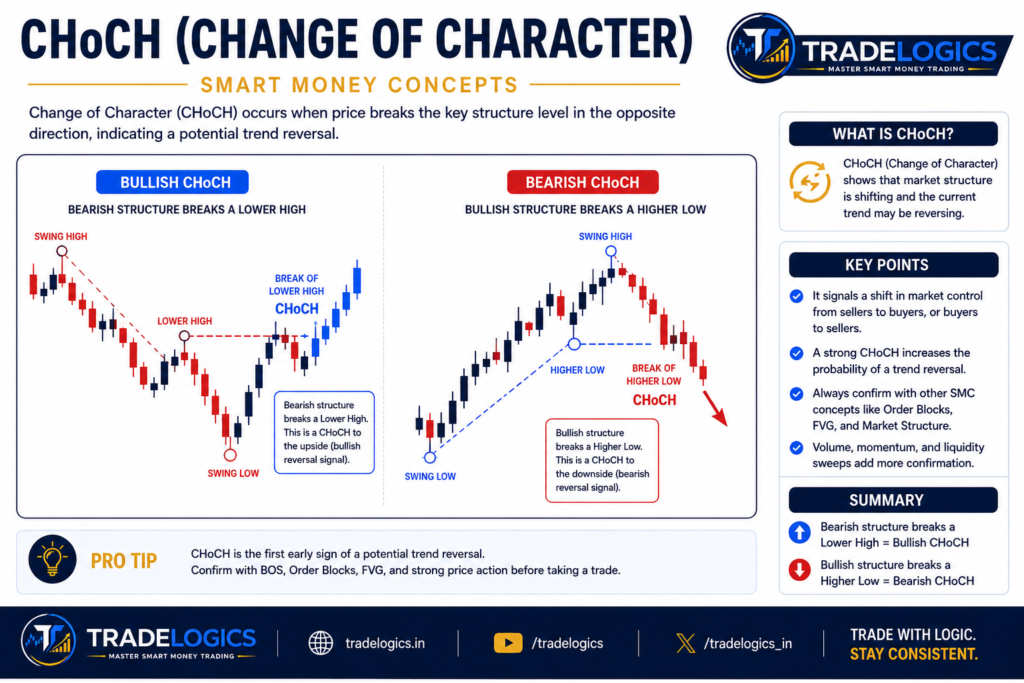
If price then breaks an important Higher Low, the movement may be interpreted as a bearish CHoCH because price has broken against the established bullish structure.
Similarly, if a bearish market has been producing:
LL → LH → LL → LH
and price breaks an important Lower High, traders may interpret the movement as a bullish CHoCH.
Bullish CHoCH
A bullish CHoCH can occur when a bearish market breaks an important Lower High to the upside.
The bearish structure may look like:
LL → LH → LL → LH
If price subsequently breaks above a meaningful LH, the market may be showing a potential shift toward bullish behavior.
The simplified sequence is:
Bearish Structure → Break of LH → Potential Bullish CHoCH
This does not automatically mean that a new uptrend has been confirmed.
The trader should wait for additional structural evidence.
Bearish CHoCH
A bearish CHoCH can occur when a bullish market breaks an important Higher Low to the downside.
The bullish structure may look like:
HH → HL → HH → HL
If price then breaks below a meaningful HL, the market may be showing a potential shift toward bearish behavior.
The simplified sequence is:
Bullish Structure → Break of HL → Potential Bearish CHoCH
Again, the break should be treated as information about changing market behavior rather than an automatic sell signal.
Break of Structure and Change of Character in SMC
Break of Structure and Change of Character help traders interpret structural continuation and potential changes in market behavior. BOS is generally associated with continuation, while CHoCH is commonly used to identify a potential shift in the existing market structure.
Break of Structure and Change of Character: Key Differences
Break of Structure and Change of Character are closely related concepts, but they serve different purposes in structural analysis.
| Concept | Main Purpose | Typical Structural Direction |
|---|---|---|
| Bullish BOS | Continuation | Break above significant high |
| Bearish BOS | Continuation | Break below significant low |
| Bullish CHoCH | Potential change | Break above significant Lower High |
| Bearish CHoCH | Potential change | Break below significant Higher Low |
The easiest way to remember the difference is:
BOS = Continuation
CHoCH = Potential Change
This is a simplified framework. In real market analysis, the significance of a break depends on the timeframe, structural level, liquidity, displacement, and broader context.
Understanding BOS in a Bullish Market
Consider a bullish structure:
HH → HL → HH → HL
The market is making higher highs and higher lows.
Price then rallies again and breaks the previous HH.
This creates:
HH → HL → HH → HL → BOS
The break confirms that price has continued to expand in the existing bullish direction.
A trader may then wait for a retracement instead of immediately entering after the break.
For example:
Bullish Structure
↓
Bullish BOS
↓
Retracement
↓
FVG / Order Block
↓
Lower-Timeframe Confirmation
↓
Potential Entry
This is more structured than buying simply because price moved above a previous high.
Understanding BOS in a Bearish Market
Now consider:
LL → LH → LL → LH
The market is making lower lows and lower highs.
Price then falls below the previous LL.
This creates a bearish BOS.
The structural sequence becomes:
LL → LH → LL → LH → BOS
Again, the break does not necessarily mean that the trader should immediately sell.
A retracement may provide a better location for evaluating a potential setup.
Understanding CHoCH in a Bullish Market
Suppose price is forming:
HH → HL → HH → HL
This is a bullish structure.
Price then falls below an important HL.
The market has now violated an important part of the bullish sequence.
This may be interpreted as:
Bearish CHoCH
The key point is that the break is occurring against the existing bullish direction.
The market may be transitioning from bullish behavior toward bearish behavior.
However, a trader should avoid assuming that one break automatically creates a new downtrend.
Further confirmation may be necessary.
Understanding CHoCH in a Bearish Market
Suppose price is forming:
LL → LH → LL → LH
This is bearish structure.
Price then rallies above an important LH.
The bearish sequence has been challenged.
This may be interpreted as:
Bullish CHoCH
The break indicates that buyers have gained enough strength to violate an important bearish structural level.
The market may be transitioning toward bullish behavior.
Again, this is a potential structural shift, not a guaranteed reversal.
Why the Previous Structure Matters
A BOS or CHoCH cannot be interpreted properly without knowing the structure that existed before the break.
For example, suppose price moves above a minor high on a 5-minute chart.
That movement alone does not necessarily mean a bullish BOS.
The trader needs to know:
- Was that high structurally significant?
- What was the higher-time-frame direction?
- Was the level part of a meaningful swing?
- Was liquidity resting around the level?
- Was there strong displacement?
- What happened after the break?
The same principle applies to CHoCH.
A minor violation of a small internal swing should not automatically be treated as a major market reversal.
The concept of identifying trends through successive highs and lows has roots in classical technical analysis and Dow Theory.
External and Internal Structure
Market structure can exist at different levels.
A higher-time-frame swing can represent external structure, while smaller movements inside that swing can represent internal structure.
For example:
Daily Structure
Bullish
↓
H4 Structure
Bullish
↓
H1 Internal Structure
Temporary Bearish Movement
This does not necessarily mean that the Daily trend has reversed.
The smaller structure can simply represent a correction inside the larger market movement.
This distinction is important when interpreting BOS and CHoCH.
A trader should always know whether the observed break represents:
- A major structural break.
- An internal structural break.
- A temporary correction.
- A potential larger trend change.
Break of Structure and Change of Character Across Multiple time frames
Break of Structure and Change of Character can appear on every timeframe, from higher-time-frame market analysis to lower-time frame trade execution.
A trader may analyze:
Daily → 4H → H1 → 15M → 5M → 1M
However, the significance of each structural break depends on the timeframe.
A 1-minute BOS may be useful for lower-time frame execution but may have little influence on the Daily structure.
Similarly, a Daily structural break can have much greater significance for the broader market direction.
A practical approach is:
Higher Timeframe
Identify the broader market structure and directional context.
Middle Timeframe
Study important structural levels and potential areas of interest.
Lower Timeframe
Look for confirmation and more precise execution.
This creates a top-down analytical process rather than treating every BOS or CHoCH equally.
Break of Structure and Change of Character in Trade Execution
One of the most common beginner mistakes is entering immediately after seeing a BOS.
For example:
Price breaks resistance → Trader immediately buys
This can be problematic because price may retrace after the break.
A more structured approach is to ask:
- What was the higher-time-frame bias?
- Which structural level was broken?
- Was the break meaningful?
- Did price show strong displacement?
- Is there liquidity nearby?
- Is there an FVG or Order Block?
- Can a lower-time frame confirmation provide a better entry?
- Where is the logical invalidation level?
- What is the potential risk-to-reward relationship?
BOS provides context.
It does not eliminate the need for trade planning.
Break of Structure and Change of Character: Reversal Context
Another common mistake is assuming:
CHoCH = Guaranteed Trend Reversal
That interpretation is too simplistic.
A CHoCH can indicate that the previous market behavior is being challenged.
However, price may:
- Reverse completely.
- Create a temporary correction.
- Form another range.
- Continue the original trend after a false shift.
- Sweep liquidity before continuing.
Therefore, traders should use CHoCH as a structural warning or potential shift rather than a guaranteed reversal signal.
BOS, CHoCH and Liquidity
Liquidity is an important part of interpreting structural breaks.
Markets often interact with obvious highs and lows before making a significant directional move.
For example, price may approach equal highs, sweep the liquidity above them, and then move lower.
A trader should therefore avoid interpreting every break in isolation.
The broader sequence may look like:
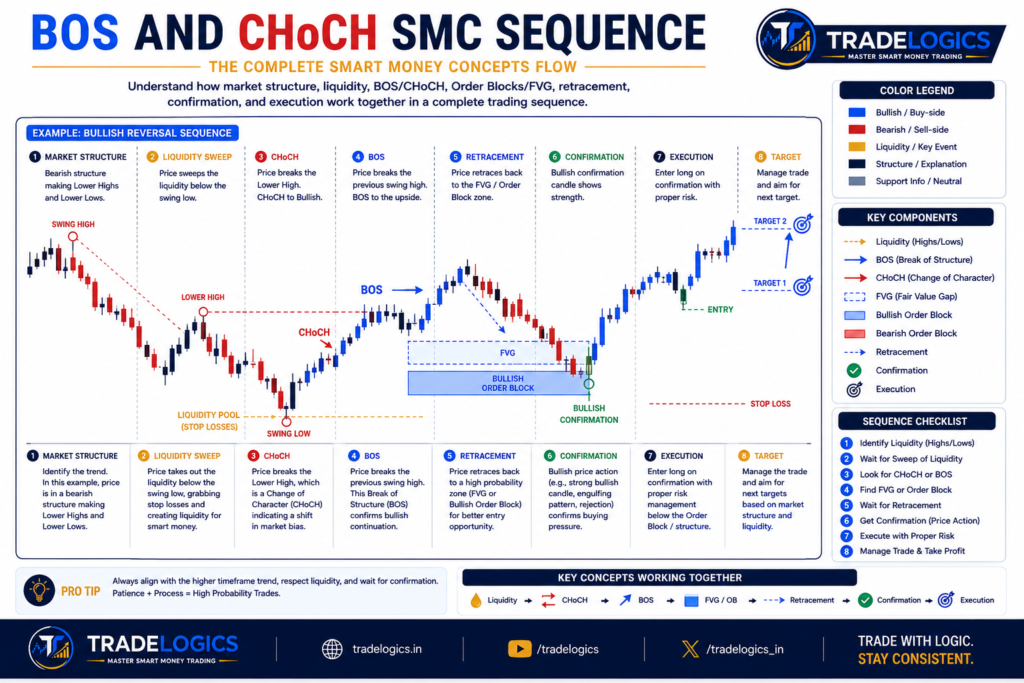
Liquidity → Structural Shift → BOS / CHoCH → Retracement → Execution
This is why Liquidity is the next major concept in the TradeLogics SMC learning sequence.
BOS, CHoCH and Fair Value Gap
After a strong structural break, price may leave an imbalance or Fair Value Gap.
A trader can then evaluate whether price returns toward that area.
A simplified bullish sequence can be:
Bullish Market Structure
↓
Liquidity Event
↓
Bullish BOS
↓
Bullish Displacement
↓
FVG
↓
Retracement
↓
Lower-Timeframe Confirmation
This does not mean every BOS must create a tradable FVG.
It simply demonstrates how structural analysis can connect with other SMC concepts.
BOS, CHoCH and Order Blocks
Order Blocks can also become relevant after a structural break.
For example, after a bullish BOS, a trader may identify a potential bullish Order Block within the preceding price movement.
If price later retraces toward that area, the trader can evaluate whether the zone remains valid and whether lower-time frame confirmation exists.
The same logic can be applied to bearish setups.
The important principle is:
Structure provides context.
BOS or CHoCH provides structural information.
FVG and Order Block can provide potential areas of interest.
lower-time-frame confirmation can support execution.
How to Identify a BOS
Use the following process when evaluating a potential BOS.
Step 1: Identify the Existing Trend
Determine whether the market is bullish, bearish, or ranging.
Step 2: Mark Significant Swing Points
Identify the important Higher Highs, Higher Lows, Lower Highs, and Lower Lows.
Step 3: Identify the Relevant Structural Level
Determine which previous high or low would represent meaningful continuation if broken.
Step 4: Wait for the Break
Observe whether price actually breaks the level.
Step 5: Evaluate the Context
Consider:
- Timeframe
- Market direction
- Liquidity
- Strength of the move
- Location
- Follow-through
Step 6: Wait for Confirmation if Required
A structural break can provide context, but the trader may still wait for a retracement or lower-time frame confirmation before entering.
How to Identify a CHoCH
The process is similar but focuses on a break against the existing structure.
Step 1: Identify the Existing Trend
Determine whether the market is currently bullish or bearish.
Step 2: Mark the Protected Structural Level
In a bullish market, pay attention to important Higher Lows.
In a bearish market, pay attention to important Lower Highs.
Step 3: Observe the Break
A break against the existing structural direction can indicate a potential change in behavior.
Step 4: Evaluate the Context
Consider whether the break is significant or merely an internal fluctuation.
Step 5: Look for Further Confirmation
Do not automatically assume that CHoCH means a complete reversal.
Observe what price does next.
Common BOS and CHoCH Mistakes
1. Calling Every High or Low a Structural Level
Not every minor swing is important.
Focus on meaningful structural points.
2. Entering Immediately After BOS
A BOS does not guarantee that price will continue without retracement.
3. Treating Every CHoCH as a Reversal
CHoCH indicates potential change in behavior, not guaranteed reversal.
4. Ignoring Higher-Timeframe Structure
A lower-time frame CHoCH may simply represent a correction inside a higher-time-frame trend.
5. Ignoring Liquidity
Structural breaks often become more meaningful when analyzed alongside important liquidity areas.
6. Using BOS and CHoCH Without Context
A label alone is not a complete trading strategy.
The surrounding structure and price behavior matter.
7. Confusing Internal and External Structure
A small internal break should not automatically be interpreted as a major change in the broader market.
Break of Structure and Change of Character Checklist
Before considering a Break of Structure and Change of Character setup, ask:
- What is the current market structure?
- Is the market bullish, bearish, or ranging?
- Which swing high or low is structurally important?
- Is the break occurring in the direction of the existing trend?
- If yes, could this represent BOS?
- If the break is against the trend, could this represent CHoCH?
- Is the broken level significant on the selected timeframe?
- Is there nearby liquidity?
- Did price show strong displacement?
- Is there an FVG or Order Block after the move?
- Does the higher timeframe support the interpretation?
- Is additional confirmation required before execution?
- Where is the logical invalidation level?
- Is the potential trade compatible with the risk plan?
Key Takeaways
- BOS and CHoCH should be interpreted only after understanding existing market structure.
- BOS is generally associated with continuation of the prevailing structural direction.
- Bullish BOS occurs when price breaks an important structural high in a bullish context.
- Bearish BOS occurs when price breaks an important structural low in a bearish context.
- CHoCH describes a potential change in market behavior.
- Bullish CHoCH can occur when a bearish structure breaks an important Lower High.
- Bearish CHoCH can occur when a bullish structure breaks an important Higher Low.
- A BOS or CHoCH is not automatically a trade entry.
- higher-time-frame and lower-time frame structure can differ without necessarily contradicting each other.
- Liquidity, FVGs, Order Blocks, and price action can provide additional context after a structural break.
- Internal and external structure should be distinguished.
- Risk management remains essential even when the structural setup appears clear.
Frequently Asked Questions
What is Break of Structure (BOS)?
Break of Structure is a structural break that occurs when price moves beyond a significant high or low in the direction of the prevailing market structure.
What is Change of Character (CHoCH)?
Change of Character is commonly used to describe a significant structural break against the prevailing market direction that may indicate a potential change in market behavior.
Is BOS bullish or bearish?
BOS can be bullish or bearish. A bullish BOS generally breaks a significant high, while a bearish BOS generally breaks a significant low.
Is CHoCH a reversal signal?
CHoCH can indicate a potential change in market behavior, but it does not guarantee a complete trend reversal.
What is the main difference between BOS and CHoCH?
The simplified distinction is:
BOS = continuation
CHoCH = potential change
The actual interpretation depends on the existing market structure and the significance of the broken level.
Should I enter immediately after BOS?
Not necessarily. Traders may wait for a retracement, FVG, Order Block, liquidity interaction, or lower-time frame confirmation before considering an entry.
Can BOS and CHoCH occur on lower time frames?
Yes. They can appear on multiple time frames. However, a lower-time frame structural break may represent only an internal movement within a larger higher-time-frame trend.
Conclusion
Break of Structure and Change of Character help traders understand what price is doing after an existing market structure has been established.
BOS is primarily associated with continuation. When a bullish market breaks an important high or a bearish market breaks an important low, the structural move can provide evidence that the existing directional behavior is continuing.
CHoCH is primarily associated with a potential change in behavior. When a bullish market breaks an important Higher Low or a bearish market breaks an important Lower High, the market may be showing signs that its previous directional behavior is weakening or changing.
The most important point is that neither BOS nor CHoCH should be treated as an isolated entry signal.
A more complete SMC analysis begins with:
Market Structure
↓
Liquidity
↓
BOS / CHoCH
↓
FVG / Order Block
↓
Lower-Timeframe Confirmation
↓
Entry
↓
Stop Loss
↓
Take Profit
This structured approach helps traders understand the market before attempting to execute a trade.
For TradeLogics, BOS and CHoCH represent Step 2 of the Smart Money Concepts learning framework. Once market structure is understood, these concepts provide the next layer of information about continuation and potential changes in market behavior.
Next Concept: Liquidity